Brazil’s Capacity Reserve Auctions for Power from Battery Energy Storage Systems are scheduled for December 2, 2026 (LRCAP National Storage) and December 4, 2026 (LRCAP Storage). In preparation for this important milestone in Brazil’s power sector, Intertechne supported the development and registration of 49 Battery Energy Storage System (BESS) projects, representing a combined 1,910 MW of power capacity and 7,640 MWh of energy storage capacity.
The projects were developed for different players in the power sector and include both stand-alone energy storage systems and solutions integrated with different generation sources, such as photovoltaic, wind, thermal and hydropower plants.
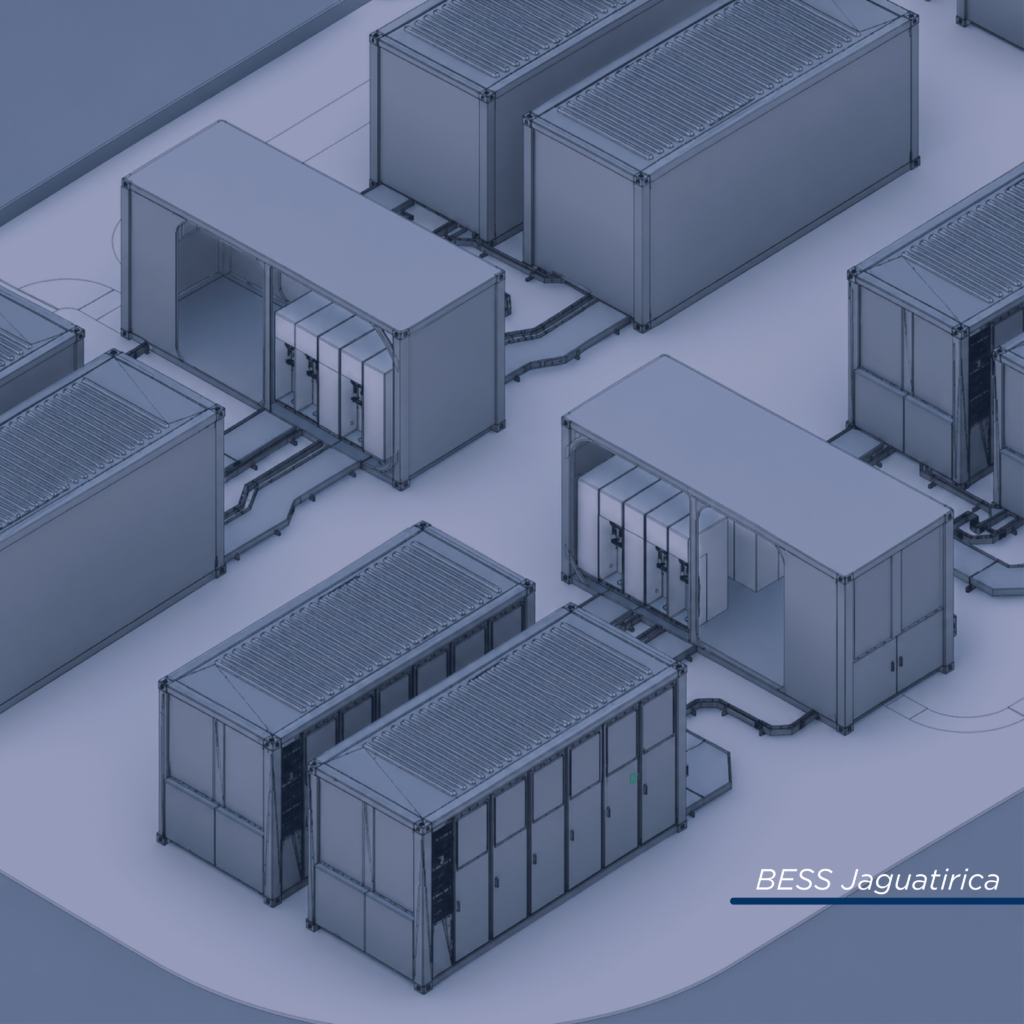
Intertechne’s involvement covered a broad range of engineering activities required for project registration. These included the preparation of layouts, site plans, single-line diagrams, technical descriptions and data sheets, as well as electrical studies to assess transmission capacity margins, short-circuit levels and power flows.
The company also supported the definition of site alternatives and grid connection points, provided inputs for financial modeling and environmental licensing processes, and carried out technical and economic assessments of suppliers and technologies, including LCOS (Levelized Cost of Storage) analyses, an indicator used to assess the levelized cost of energy storage.
Integrated Engineering for Different Solutions
The development of the projects required the integration of multiple engineering disciplines, particularly electrical, electromechanical and civil engineering. The studies covered everything from access roads, drainage, earthworks and foundations to the design of electrical systems, including cables, cable trays, grounding, auxiliary systems, communications, CCTV and integration with substations.
Other aspects assessed included equipment layout, safety clearances, cable routing, accessibility for construction and operations and maintenance (O&M), as well as the definition of substation entry points and electrical interconnections through overhead and underground medium-voltage networks.
This multidisciplinary approach makes it possible to assess the energy storage system not as an isolated piece of equipment, but as part of an integrated solution, taking into account its interaction with other project assets and with the power grid.
It is precisely this experience accumulated by Intertechne across generation, transmission and infrastructure projects that contributes to the development of more robust and competitive energy storage solutions. The company’s previous work with photovoltaic, wind, hydropower and thermal power plants, as well as substations and transmission lines, provides a comprehensive understanding of the different elements that need to be considered in a BESS project.
A Highly Competitive Market
The registration of approximately 300 GW of BESS projects for the 2026 LRCAP Storage auction demonstrates the strong market interest in the technology. This volume, however, represents a supply level far above the capacity expected to be contracted, pointing to a highly competitive environment among the projects.
In this context, the quality of the basic design becomes strategically important. Beyond meeting the auction’s technical requirements, projects need to minimize implementation risks and create the conditions for economically competitive bids.
Proper system definition, selection of the grid connection point, infrastructure optimization, and the choice of technologies and suppliers can directly influence project competitiveness. A more detailed basic design also enables more reliable estimates of implementation costs, material quantities, supplier quotations and overall costs, helping reduce uncertainty and optimize CAPEX and OPEX.
Next Steps
With the registration stage completed, the projects move on to technical analysis and qualification by the Empresa de Pesquisa Energética (EPE), Brazil’s Energy Research Office, where regulatory, technical and grid connection requirements will be assessed.
Intertechne continues to support its clients throughout this stage, assisting with responses to requests for clarification, supplementary information and any technical requirements from EPE. At the same time, the company is already working on further developing the basic designs, with a focus on the technical and economic optimization of the projects.
The next stages include refining system sizing in MW/MWh, assessing and selecting technologies and suppliers, identifying alternatives to reduce grid connection and infrastructure costs, and maximizing the amount of power that can be contracted at the available grid connection points.